



From the search results asset to the product page header, here is how app marketers in Latin America can design creative assets and custom product pages for Buen Fin, Black Friday, Cyber Monday and Christmas.
Imagine a shopper browsing the App Store ahead of Black Friday. It’s 11:40 on a Thursday night in São Paulo. Camila is on the couch, half-watching a series, thumb already hovering over the App Store. She types “promoção Black Friday” and scrolls. Every app on the screen looks pretty much the way it did back in March, except one, whose ad opens with “frete grátis + cashback na primeira compra.” She taps that one.
In Brazil, e-commerce revenue grew 41.3% during the first week of November 2024 compared with the same period in 2023. During Black Friday week itself, revenue grew by 10.5% year on year, according to figures reported by Confi.Neotrust [1]. That suggests demand was already building well before Black Friday week.
For app marketers, that makes preparation the key. Creative assets and custom product pages can help align the App Store experience with different shopping needs, product categories and campaign messages before demand even peaks.
Source: [1] WideCommerce, “Black November: faturamento total no mês foi de R$ 36,7 bilhões, mostra Confi.Neotrust” (6 December 2024)
1. The search results asset: your first impression
This is a dedicated image or video that can appear with your app in App Store search results, instead of the default screenshots.
How to design it for Latin America and for Black Friday:
• Build one asset per search intent, not one per app. Someone searching “ofertas Buen Fin” wants something different from someone searching “frete grátis.” Pair each asset with a custom product page built for that intent.
• Design for silence. Put the message on screen, in the shopper’s language, and show the app in use.
• Lead with the moment and one local cue. Use the sale name people know (Buen Fin in Mexico, Black Friday in Brazil) and, where true for your app, a payment cue such as Pix or installments.
2. The product page header: the continuation after the tap
The header is a wide image or video at the top of the product page. Videos are muted by default, though people can unmute. It can be set per localization and used on both your default product page and your custom product pages.
Smartphones account for 83% of LATAM e-commerce site traffic and almost three-quarters of online retail transactions [2] so most people will meet your header on a small screen, in a hurry. Social platforms are part of the picture too: in Brazil and other Latin American countries, consumers engage with brands on WhatsApp, Instagram and Facebook, [3] so visuals that feel quick and native to a phone are likely to feel familiar.
How to design it:
• Treat it as the second beat of the same story. Echo the search results asset: same words, same colors, same promise. The shopper should feel they landed where they meant to.
• Set the mood of the moment. Black Friday headers can carry energy and urgency. Christmas headers can carry warmth, family and gifting.
• Localize it properly. A Portuguese header for Brazil and a Spanish header for Mexico, not one shared version.
Source: [2] Statista, “E-commerce in Latin America” | [3] PPRO, “Why Latin America is the next big market for e-commerce merchants” suggests demand was already building well before Black Friday week.
3. The universal asset: one creative, two placements
App Store Connect lets one header asset also serve in search results. The only image size both placements accept is 16:9, so a universal asset has to be designed at that ratio [4].
• Use it where you need speed or scale, such as secondary countries or regions, and build dedicated assets for your highest-volume ones.
• Keep text and the product away from the edges. The two placements use different shapes, so check both in the preview tool.
Source: [4] Adapty, “App Store Asset Library is live: headers, search, PPO, Duo”
4. Custom product pages and product page optimization: where assets get tested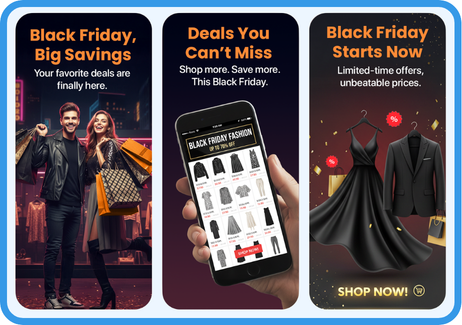 Custom product pages let developers create additional App Store product pages, each with its own screenshots, app previews, promotional text and URL, and up to 70 additional pages per app. App Marketers can also assign keywords to a custom product page so it can appear in App Store search results for those terms, with each keyword combination unique to a single page. Creative assets can be used on custom product pages too, so one app can run a different header and search results asset for each audience [5].
According to data shared on Apple Developer, that developers see an average 2.5 percentage point increase in conversion rate when referring people to a custom product page. [6], a 156% increase compared with the 1.6% average on default product pages. That is a cross-developer average, not a forecast for any one app, which is why testing matters.
Product page optimization can now test creative assets as well. Some test ideas that suit Latin America:
• Urgency versus value: a countdown-style message against a “best value” message.
• Payment cue versus no cue: does showing Pix, installments or PSE change
conversion?
• Local idiom versus neutral wording: for Spanish, test local phrasing against a more generic version.
Source: [5] Adapty, “App Store Asset Library is live: headers, search, PPO, Duo” | [6] Apple Developer, “Custom product pages on the App Store”
Here is the problem. Four countries or regions, four shopping moments, and three search intents already make 48 combinations, before you count languages, video cuts, and tests. Doing that manually means either missing the window or settling for generic.
OpticksAI is Newton’s creative intelligence engine, working alongside Niko to turn market insights into more relevant, high-performing creatives and custom product pages. It automates custom product page creation at scale, drawing on multiple App Store sources, including app metadata and competitor data, to generate text, visuals and layouts shaped by your brand identity.
● Event-specific and multilingual: it detects trends to generate timely pages for Buen Fin, Black Friday and Christmas, with AI-driven localization for Portuguese and Spanish audiences.
● Keywords and creative together: it analyzes your metadata, descriptions and
screenshots to find high-impact keywords, then aligns the top performers with matching creatives.
● Brand and compliance: it keeps your brand consistent and follows the App Store guidelines to support smooth approvals.
● Built for testing: it generates multiple custom product page variations in minutes for rapid A/B testing.
● Fast edits and flexible export: adjust backgrounds, logos and text with AI suggestions or your own inputs, and export in formats including PNG and SVG.
The loop: Niko, OpticksAI and Telescope
1. Niko reads the market. It analyzes campaign performance, search behavior, keyword opportunities and competitor signals to show what audiences are looking for and which creatives are resonating.
2. OpticksAI builds the creative. Using Niko’s intelligence, it generates brand-aligned, competitor-informed text, visuals and layouts with high-intent keywords. Its optimized templates let you build custom product pages and App Store assets for each audience, country or region and shopping moment.
3. Testing and Telescope close the loop. OpticksAI generates variations for side-by-side A/B testing, Niko analyzes the results to show what works, and Telescope brings Apple Ads and App Store Optimization data together, from keyword selection to creative testing, to show how search demand is shifting and when opportunities emerge. Those insights feed the next round of creative.
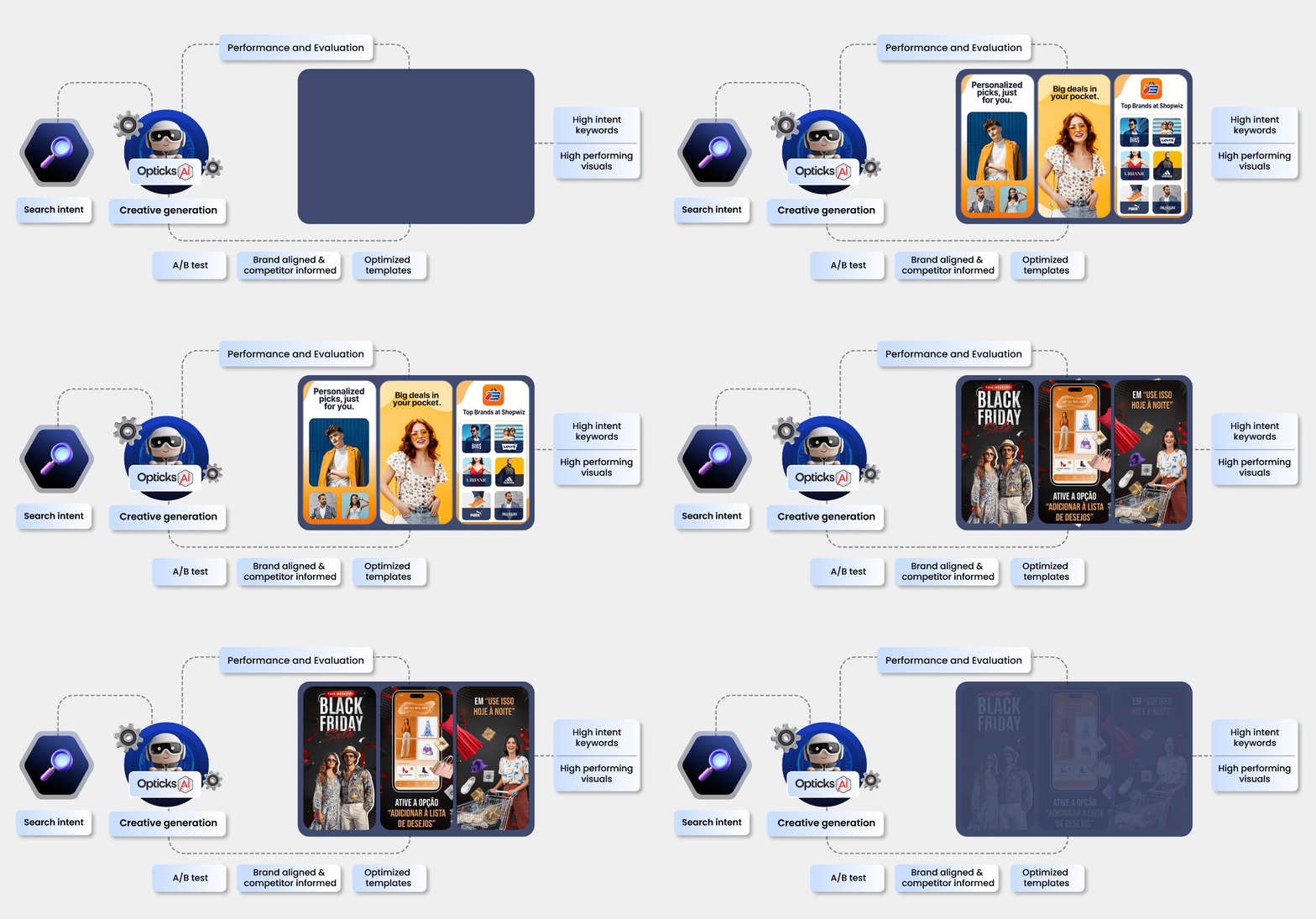 Together, Newton’s tools connect search intelligence, creative generation and campaign optimization in one continuous workflow.
How Can Brands Adapt to Latin America's Diverse Black Friday Markets?
Black Friday in Latin America is not a single day and not a single market. Mexico opens the season with Buen Fin, Brazil builds through Black Friday and the 13th salary, and the shopper in each country is looking for something slightly different. Creative assets give you more room than ever to meet them there, and custom product pages carry that message through to the App
Store experience.
Newton is an Apple Ads Partner. It supports app marketers with solutions such as OpticksAI and Telescope to inform creative strategy and App Store intelligence. Combine them with a well-planned seasonal campaign, and you can move beyond generic Black Friday messaging and build experiences that reflect what each audience is looking for.
Ready to make your festive campaigns more relevant? Talk to Newton and let us help you plan, create and test every asset this season.
Frequently Asked Questions
