





Ramadan 2026 iOS app marketing guide for the Gulf. Learn Apple Ads strategy, GCC keywords, bidding phases, and peak app usage during suhoor and iftar.
Ramadan is a cultural phenomenon that completely reshapes user intent in the Gulf. During the month mobile behavior shifts sharply as search activity on apps rises, sessions lengthen, and spending concentrates in short bursts. Across the Middle East, AppsFlyer found non-organic installs rose ~27% during Ramadan, while regional app revenues topped roughly US$1.7B (≈ +18.6% YoY).
On iOS especially, users don’t browse randomly during Ramadan. They plan earlier, search more intentionally, and engage longer at very specific moments of the day. If your Apple Ads and App Store presence don’t reflect when and why people open the App Store during Ramadan, you’ll either overpay or underperform, often both.
Here is a quick yet comprehensive checklist for efficient iOS app marketing during Ramadan.
Ramadan pulls intent forward and iOS feels it first
Across the gulf, Ramadan intent shows up weeks before Ramadan begins. On iOS, this shift is even stronger, with planning-led searches and installs rising weeks ahead of Ramadan. This is driven by the fact that iOS users in GCC markets like UAE, Saudi Arabia, Qatar, and Kuwait:
● Tend to plan purchases and decisions earlier
● Rely heavily on App Store search (vs social discovery)
● Respond strongly to seasonal and contextual keywords at the top-of-the-funnel
What this means in practice:
● iOS users acquired during 2–4 weeks before Ramadan are extremely cost effective and high-intent
● Mid-Ramadan CPIs inflate fast, especially for shopping, finance, gaming & entertainment and food delivery
● Ramadan should be treated as an early acquisition season on iOS. If your biggest Apple Ads budget push starts on Day 1 of Ramadan, you’re already late.
What people in the Gulf actually search during Ramadan
Below are high-intent, non-brand keyword clusters that consistently show volume and conversion during Ramadan across GCC (UAE, Saudi Arabia, Qatar, Kuwait) markets:
● For shopping and deals, users commonly search for “ramadan offers,” “eid sale,” “ramadan shopping,” “eid gifts,” and “iftar deals,” along with Arabic variants such as “عروض رمضان,” “عروض العيد,” and “هدايا العيد.”
● For food and delivery, high-intent searches include “iftar delivery,” “suhoor food,” “ramadan meals,” and “iftar near me,” supported by Arabic terms like “إفطار,” “سحور,” and “وجبات رمضان.”
● For finance and payments, users search for “zakat calculator,” “ramadan charity,” “money transfer app,” and “send money eid,” with Arabic intent captured through “زكاة” and “صدقة.”
These keywords convert best before and early into Ramadan, because early Ramadan is what builds intent while mid-Ramadan reinforces habits (shifting focus towards brand keywords).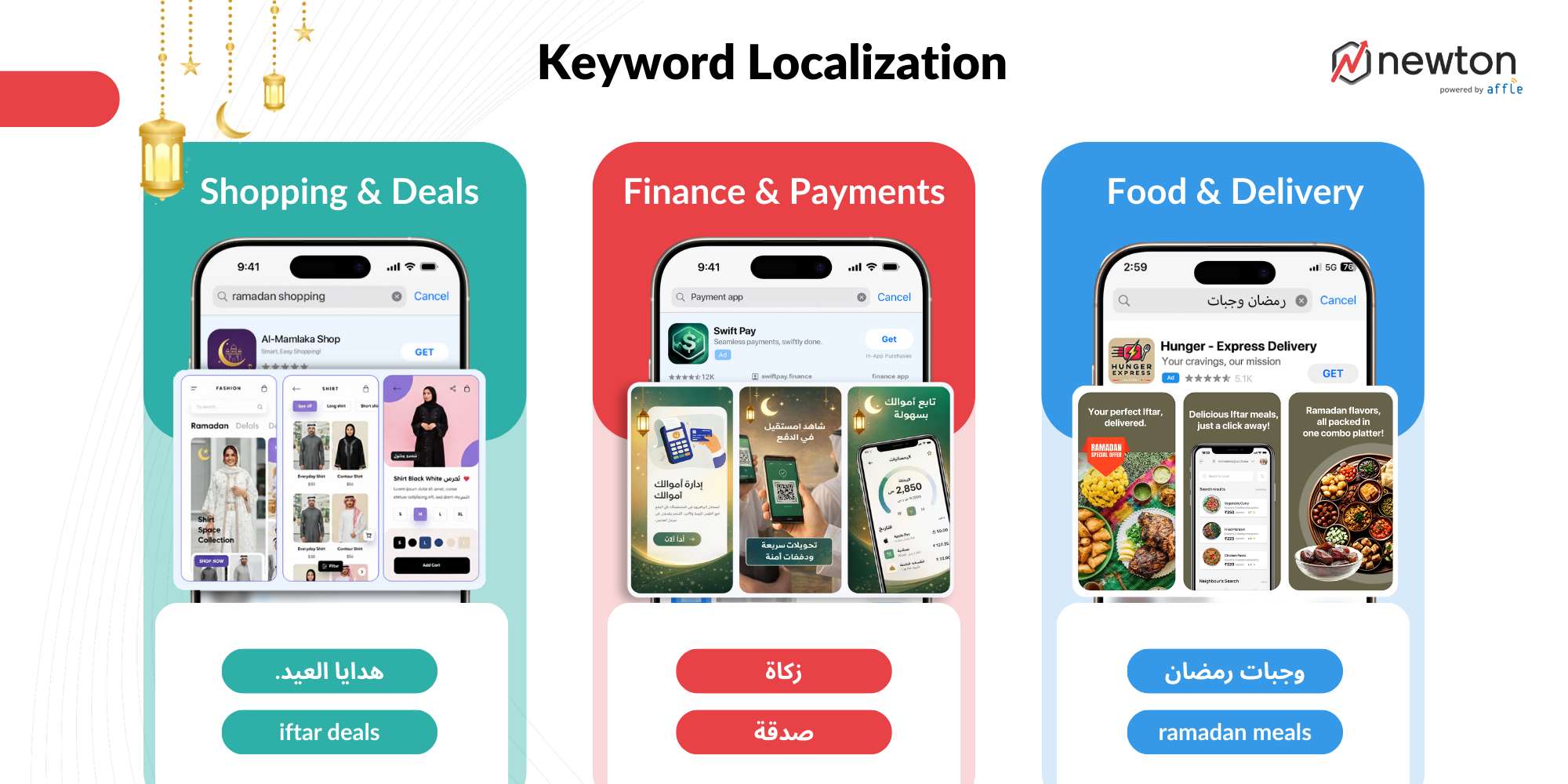
Navigating Apple Ads Campaigns during Ramadan
1. Structure campaigns by Ramadan intent
Instead of structuring campaigns as Generic | Brand | Competitor, organize them around how intent evolves during Ramadan:
● Planning intent (pre-Ramadan)
● Daily need intent (food, utility, habits), and
● Eid intent (gifting, payments, travel).
This structure allows you to:
● Scale budgets aggressively early when CPIs are stable
● Reduce spend mid-Ramadan without breaking the campaign
● Scale Eid-related keywords only when demand peaks.
2. Bid strategy by phases
● Pre-Ramadan (−30 to −7 days):
Use the highest bid caps, focus on generic and Ramadan-specific keywords, and optimize for cost-effective, high-quality users who are still in planning mode.
● Early Ramadan (Week 1–2):
Maintain bids, start removing low-converting terms from your campaigns, and start featuring Ramadan-themed custom product pages to match messaging with searches that reflect early-Ramadan intent.
● Mid-Ramadan (Week 3):
Expect CPIs to increase during this phase. Pause broad match, and increase bids toward exact-match, high-conversion keywords only.
● Pre-Eid (last 7–10 days):
Reallocate budget toward high-intent terms such as “eid,” “gifts,” “sale,” and “transfer.” This is a short window with high intent and strong conversion rates.
3. Creative execution inside Apple Ads
Most Ramadan creatives fail because they look festive but say nothing. High-performing creatives answer one clear question: “Why is this app useful right now?”
● For shopping apps, replace generic lines like “Ramadan Sale 🎉” with utility-led messages such as “Everything you need before Iftar,” “Eid gifts delivered before the last 10 nights,” or “One app for Ramadan shopping.”
● For food apps, use lines like “Plan suhoor in 2 minutes,” “Iftar delivered when it matters,” or “No cooking after fasting.”
● For finance apps, effective messaging includes “Send money before Eid in seconds,” “Zakat calculated, paid, done,” or “One-tap charity during Ramadan.”
These creatives should be applied through custom product pages that are explicitly matched to keyword intent. For example, keywords like “iftar delivery” should trigger screenshots that mention iftar, while keywords like “zakat” must show creatives that mention zakat calculator. This alignment consistently improves Tap-through rate (TTR) and Conversion Rates (CVR) without aggressively increasing bids.
4. Suhoor, Iftar & late-night behavior
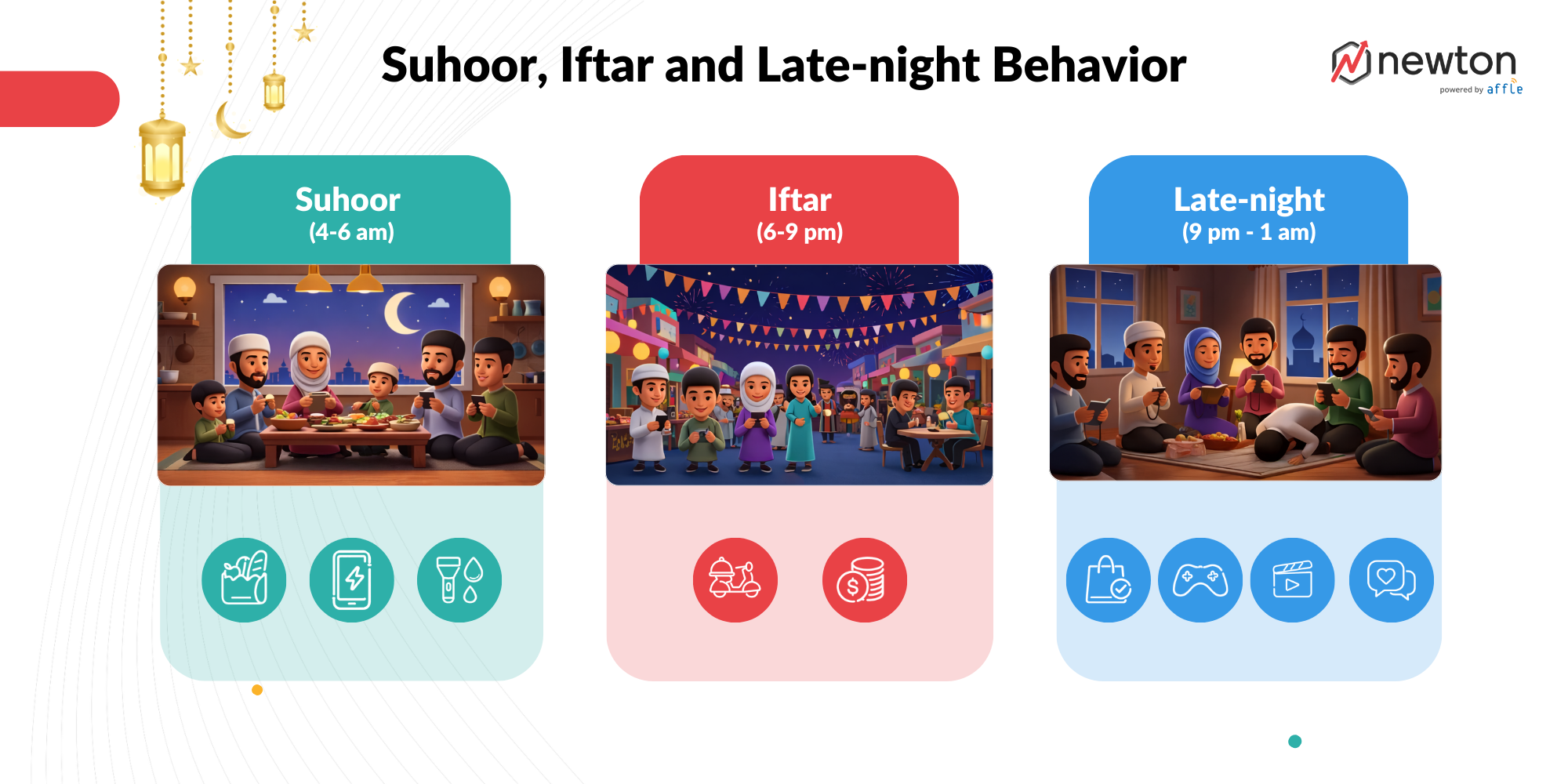
Ramadan completely reshapes daily rhythms in the Gulf, and Apple Ads performance reflects this clearly. User activity clusters around three key windows, with post-iftar hours delivering the longest sessions, highest willingness to install, and strongest engagement:
● Suhoor (4–6 AM) - Increased activity for food planning, recipes, grocery apps, utilities
● Iftar (6–9 PM) - High engagement across Food Delivery, Quick-commerce and Fintech app categories
● Late-night (9 PM–1 AM) - Peak session length for Shopping, Gaming and Entertainment apps
It is most effective during Ramadan to review hourly performance, not just daily averages. If CPIs improve post-iftar, raise bids only for those late-night hours and shift budgets away from low-intent morning and daytime campaigns.
5. Measurement that actually works during Ramadan
Ramadan is short, so success depends on optimizing for early truth signals, not long-tail metrics.
● Apple Ads should be optimized toward full-funnel optimization across registration, add-to-cart, and first transaction, with performance compared week by week rather than across the full month.
● Core metrics to track include install-to-event conversion rate, CPI by Ramadan phase, and engagement drop post-Eid.
● Avoid judging Ramadan performance purely on monthly ROAS and don’t panic if CPIs spike mid-Ramadan because the CVR might be higher
Ramadan Rewards Timing & Precision
Ramadan doesn’t reward louder ads or bigger budgets. It rewards earlier intent capture, smarter keyword timing, creatives that respect context, and marketers who understand why users are searching what they’re searching.
On iOS, Ramadan can feel extremely short and sharp. But if you plan early, speak clearly, and respect the rhythm of the month, it remains one of the highest-quality acquisition windows of the year.
