





Discover how app marketers can prepare for India’s festive season with smarter ASO, keyword strategies and Apple Ads to capture high-intent shoppers.
Festive demand starts taking shape on the App Store long before the purchase happens. Shoppers search for products, browse categories, compare apps and discover brands before deciding what to download and where to buy. As demand shifts through the season, an app's ability to stay visible, relevant and compelling across these moments can directly shape its growth.
For e-commerce marketers, this makes the App Store more than a destination for downloads. It is where search intent, product discovery and conversion come together. The challenge is knowing when demand is building, which searches are gaining traction, how competitors are capturing that attention and how the app experience should respond.
The festive rush is shaped well before the biggest shopping moments. For e-commerce marketers, staying ahead means reading demand early, capturing the searches that matter and adapting the App Store experience as intent evolves.
1. When Should You Track Festive Momentum
Festive demand rarely arrives all at once. It builds through changing search behaviour, product interest and shopping activity well before the biggest moments. The 2026 India festive analysis covered 2.1 billion installs, 5 billion remarketing conversions and $700 million in UA and remarketing spend, tracking activity from mid-August through the end of October. Shopping also generated 15% of its seasonal iOS revenue during Navratri week, showing that e-commerce momentum can start well before Diwali.
Source: AppsFlyer
For e-commerce apps, the focus should therefore be on identifying these signals early rather than waiting for the peak. Track shifts in search behaviour, category movement, competitor activity and product interest to understand when demand is starting to accelerate. Prism’s Live Search can help turn these changes into an evolving view of what shoppers are actively looking for, giving marketers time to adapt keywords, listings and campaigns before demand peaks.
2. How to Build A Stronger Keyword Portfolio
A festive keyword strategy should go far beyond adding a few seasonal terms to metadata. Build a portfolio across products, categories, brands, competitors, occasions, locations and shopper needs, then evaluate each term by search volume, relevance, difficulty, ranking, indexing and performance.
.png?width=1920&height=1080&name=3%20(4).png) Go beyond the obvious high-volume terms. Identify the searches competitors are gaining visibility on, product and category terms showing rising demand, long-tail searches that signal stronger purchase intent and gaps where your app has little or no visibility. Map these terms across the App Store to understand which should strengthen metadata, which can inform creative and which deserve dedicated listing experiences. As festive demand shifts, keep the portfolio dynamic, dropping terms that lose relevance and expanding coverage around searches gaining traction.
Go beyond the obvious high-volume terms. Identify the searches competitors are gaining visibility on, product and category terms showing rising demand, long-tail searches that signal stronger purchase intent and gaps where your app has little or no visibility. Map these terms across the App Store to understand which should strengthen metadata, which can inform creative and which deserve dedicated listing experiences. As festive demand shifts, keep the portfolio dynamic, dropping terms that lose relevance and expanding coverage around searches gaining traction.
3. How to Let Creatives Do All the Talking
Festive shoppers make quick decisions, making the first visual experience on the App Store especially important. Product page header and search results placements on the App Store give e-commerce apps additional creative real estate to communicate seasonal offerings, product ranges, value propositions, and shopping experiences.
Source: Apple
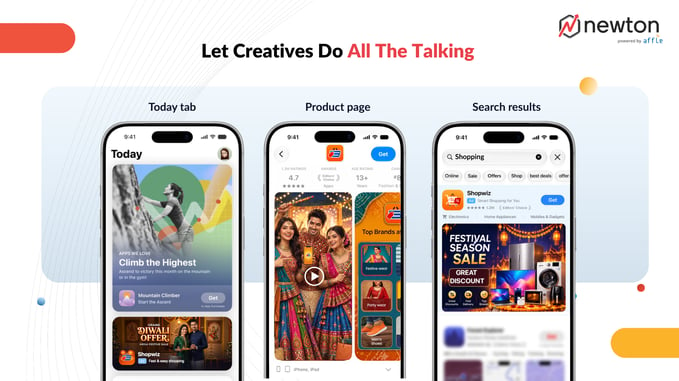
The objective should not be to make every asset look festive. Each creative should communicate a specific reason to choose the app. Search result assets can immediately establish what the app offers, while the product page header can reinforce the broader proposition. OpticksAI can help create and adapt screenshots, preview videos, icons and other assets quickly as product priorities and seasonal messaging evolve.
4. What's Already Working? Let Maximize Conversions Tell You
Festive growth is not simply about reaching more shoppers. It is about understanding which search themes and audiences are producing meaningful outcomes. Maximize Conversions can help identify where stronger conversion signals are emerging and distinguish high-volume searches from those bringing users who are more likely to take valuable actions.
This becomes particularly useful during a period when acquisition and re-engagement are both accelerating. Global Shopping UA spend grew 70% in 2025, while Shopping on iOS devices grew 123%. The strongest conversion signals from paid activity can therefore reveal which search themes and shopper groups deserve greater attention across the wider app growth strategy.
Source: AppsFlyer
5. What Search Match Is Telling You
Search Match can serve as a live source of market intelligence during a fast-changing festive period. Rather than relying entirely on a predefined keyword list, use it to identify emerging product searches, category terms, combinations and shopper needs that may not have been anticipated.
This is especially valuable when festive demand is moving quickly. The strongest signals can move into the broader keyword portfolio, metadata, creatives and custom product pages, creating a continuous connection between what shoppers are actually searching for and what the app presents to them.
6. Where Is Festive Demand Building Across Categories
There is no single festive curve for e-commerce. Shopping demand can build well before Diwali, dip during the festival itself and pick up again as shoppers return for post-festive offers. AppsFlyer’s festive data shows that shopping activity was strongest in the weeks leading up to Diwali, dipped during the festival week and saw another peak two weeks after Diwali, driven by clearance sales and promotions.
-1.png?width=1920&height=1080&name=4%20(2)-1.png) For e-commerce marketers, this makes category timing just as important as the festival calendar. Fashion can see earlier discovery as shoppers plan festive wardrobes, electronics can drive longer consideration as consumers compare products and offers, while grocery and quick-commerce can be shaped by convenience and immediate needs. The category determines when demand moves, so the App Store strategy should move with it.
For e-commerce marketers, this makes category timing just as important as the festival calendar. Fashion can see earlier discovery as shoppers plan festive wardrobes, electronics can drive longer consideration as consumers compare products and offers, while grocery and quick-commerce can be shaped by convenience and immediate needs. The category determines when demand moves, so the App Store strategy should move with it.
Source: AppsFlyer
7. Does Your Listing Match What Shoppers Search For
Once search behaviour is clear, the next step is to build the strongest version of the listing around it. App Store search considers relevance across elements such as the title, keywords, and primary category, alongside user behaviour.
That makes the listing a direct response to search intent. Look at where impressions are translating into product page views and where users are dropping before download. Compare Search and Browse performance to understand whether the challenge lies in visibility, relevance or conversion.
Prism’s App Store Builder can help marketers explore different listing directions across critical elements such as the title, metadata and keyword coverage, compare them against the live listing and assess potential impact before making changes live.
8. Should Paid And Organic Be Treated As One
Paid and organic should not operate as separate festive strategies. Apple Ads can reveal which searches are generating demand and which terms are producing stronger conversion signals, while ASO can use those learnings to strengthen organic visibility and the App Store experience.
The scale of investment makes this connection increasingly important. Shopping UA grew 123% on iOS in 2025, while iOS Shopping remarketing grew 66% [1]. Paid search can therefore provide a valuable stream of live demand and conversion intelligence that informs keywords, listings, custom product pages and creatives.
Source: [1] AppsFlyer
9. Is Your Festive Strategy Local Enough
Festive intent is shaped by region, language, culture and local shopping behaviour. Localisation should therefore go beyond translating metadata. Build regional keyword portfolios, adapt product priorities, tailor screenshots and creatives, and make the value proposition relevant to what shoppers in that market actually care about.
The need for this becomes even clearer when festive behaviour differs by market and category. A proposition that works in one market may not match the search behaviour, competitive landscape or product priorities of another. Local search signals should shape the reason to choose, rather than forcing one festive proposition across every market.
10. Can custom product pages Match Intent
Custom product pages can turn high-intent searches into more relevant product experiences. Instead of sending every shopper to the same default page, create pages around distinct product categories, seasonal propositions or search themes and align their screenshots, previews and messaging accordingly.
Apple Ads reports an average conversion rate of 2.5% when users are referred to a custom product page, compared with 1.6% for default product pages, a 156% increase. [2]
For festive campaigns, custom product pages can connect the search a shopper makes with the proposition they see next, creating a more consistent journey from discovery to download.
Source: [2] Custom product pages on the App Store
11. Where Are Competitors Leaving Gaps
Festive competition changes quickly. Competitors may alter their metadata, shift category positioning, introduce new creative, create custom product pages around different propositions or gain visibility on emerging searches.
The wider market is already becoming increasingly competitive, with Shopping investment rising 70% globally and 123% on iOS. That makes competitor intelligence useful beyond keyword rankings. Monitor changes across visibility, category position, metadata, screenshots, previews, custom product pages and propositions to understand where the market is becoming crowded and where gaps remain.
The goal is not simply to follow competitors, but to identify what shoppers are repeatedly being shown and where your app can present a distinct and relevant reason to choose it.
Source: AppsFlyer
12. What Happens After The Festive Peak
The festive period does not end when the biggest shopping moment passes. Post-peak behaviour can reveal another wave of demand, reactivation and repeat purchases. In India, iOS Shopping sessions rose 20% after Diwali, while the top 10 shopping apps increased their share of paying users by 32% year over year.
Source: AppsFlyer
E-commerce is also putting greater emphasis on re-engagement. By March 2026, 92% of iOS e-commerce app ad spend was directed towards remarketing, up from 77% a year earlier, and iOS remarketing was associated with a 118% install-to-purchase conversion uplift.
Source: AppsFlyer
The post-festive period can therefore be used not only to bring shoppers back, but also to learn from what they searched for, viewed, downloaded and purchased. Those signals can shape the next round of keywords, listings, creative and paid campaigns.
How Do You Bring It All Together
Festive e-commerce growth on the App Store is not about one campaign, one keyword, or one peak moment. It is about connecting the signals across the journey: understanding when demand starts building, identifying what shoppers are searching for, strengthening visibility, adapting the listing, matching creative to intent, connecting paid and organic learnings, and continuing to engage shoppers after the peak.
Telescope can help read visibility, competition and market signals. Prism brings together App Store optimisation, keyword discovery, performance insights and the App Store Builder to help marketers understand and improve the listing. OpticksAI helps create and adapt the creative experience, while Apple Ads adds live paid search and conversion signals.
Together, these capabilities create a continuous cycle of discovery, conversion, learning and growth, helping e-commerce apps stay relevant through every stage of festive demand.
Frequently Asked Questions
