





Explore how Gen X, Millennials, Gen Z, and Gen Alpha discover and install apps differently, and how app marketers can bridge that gap by structuring campaigns around search intent and routing users to the right App Store experience.
In mobile marketing today, it’s no longer enough to build one great App Store page and expect it to work for everyone. Different generations think differently, discover apps differently, and install apps for different reasons. Research across mobile marketing consistently shows that generational behavior influences how users search, evaluate, and commit to apps, directly impacting conversion and long-term value.
Marketing is about recognizing repeatable patterns in discovery habits, trust signals, and decision logic. While there are behavioral differences between generations, the practical execution inside Apple Ads is recommended to be built around keyword-level search intent and observable behavior signals, not age-based targeting.
How generations behave on the App Store
The table below summarizes the behavioral patterns that matter most. These insights are grounded in cross-industry research on generational media consumption, mobile usage, and digital trust.
|
Generation |
Discovery Lens |
App Store Behavior |
Decision Driver |
Typical App Categories |
|
Gen X (1965–1980) |
Search-first, problem-driven |
Scans titles, ratings, and screenshots carefully |
Certainty & usefulness |
Finance, productivity, health utilities |
|
Millennials (1981–1996) |
Social, reviews, then search |
Evaluates and compares before committing |
Value justification |
Wellness, fintech, marketplaces |
|
Gen Z (1997–2012) |
Social-first discovery |
Uses App Store for confirmation |
Expectation match |
Gaming, social, creator tools |
|
Gen Alpha (2013+) |
Videos, peers, games |
Parent-mediated install decisions |
Trust & safety |
Kids' games, learning, and interactive apps |
These generational differences change why users tap and install. Let’s translate this into execution and understand how to structure your keyword buckets, creatives, and Apple Ads campaigns around distinct search intent patterns, ensuring users land on the app aligned with their specific motivation.
Keyword strategy: segment by intent, not just volume
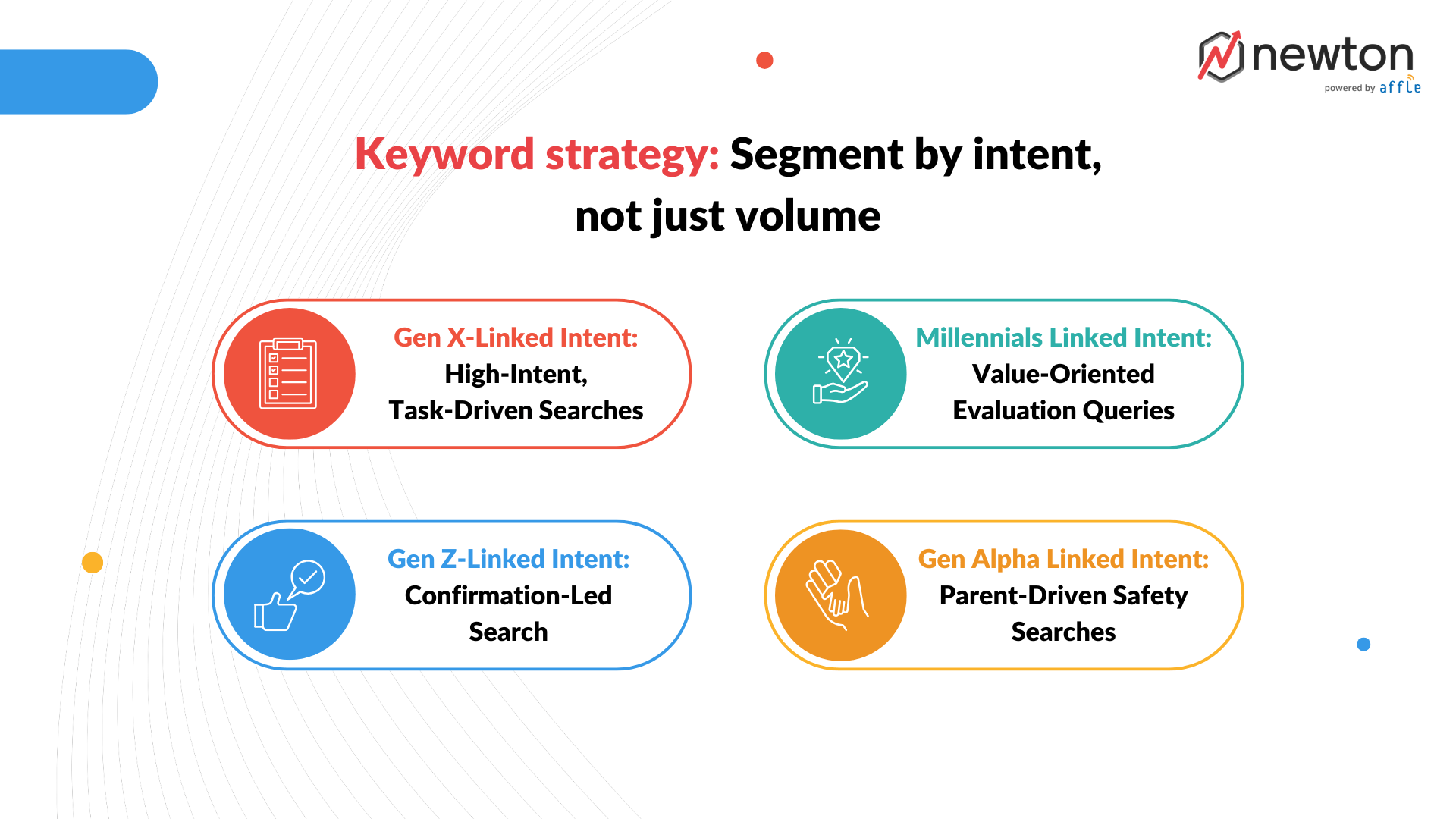
Gen X linked intent: High-intent, task-driven searches
Gen X users tend to search with explicit intent. Studies on generational search behavior show that older cohorts rely more heavily on traditional search to solve specific problems. Keywords that describe clear functions or outcomes perform best because they reduce uncertainty at the moment of search.
Millennial-linked intent: Value-oriented evaluation queries
Millennials often search in a more exploratory but still rational way. Their queries frequently imply outcomes and benefits rather than just tasks, reflecting their tendency to evaluate before committing.
Gen Z-linked intent: Confirmation-led search
Gen Z increasingly discovers apps outside the App Store, especially on social platforms. Research shows that younger users often use search as a validation step rather than a discovery tool. Brand, competitor, and feature-specific keywords, therefore, play a much larger role in Apple Ads performance.
Gen Alpha: parent-driven safety searches
Search behavior for Gen Alpha apps is frequently driven by parents, with emphasis on age suitability, learning value, and safety, a pattern reinforced by Apple’s Family Sharing and parental controls guidance.
Strategic takeaway
Search results optimization: winning the tap before the page loads
Once keywords are segmented by intent, the default App Store listing should remain neutral and broadly clear. You only have one icon, one name, and one subtitle, so the goal isn’t to tailor these to different generations, but to make them immediately understandable to anyone searching.
The exception is when your app is genuinely built for a single, dominant audience, such as kids’ learning apps, teen social platforms, or senior-focused health tools. In those cases, it makes sense for the default listing to lean clearly toward that cohort, for example, a kids’ learning app can lean into playful visuals, characters, and age cues in its icon and screenshots.
Creative optimization for custom product pages
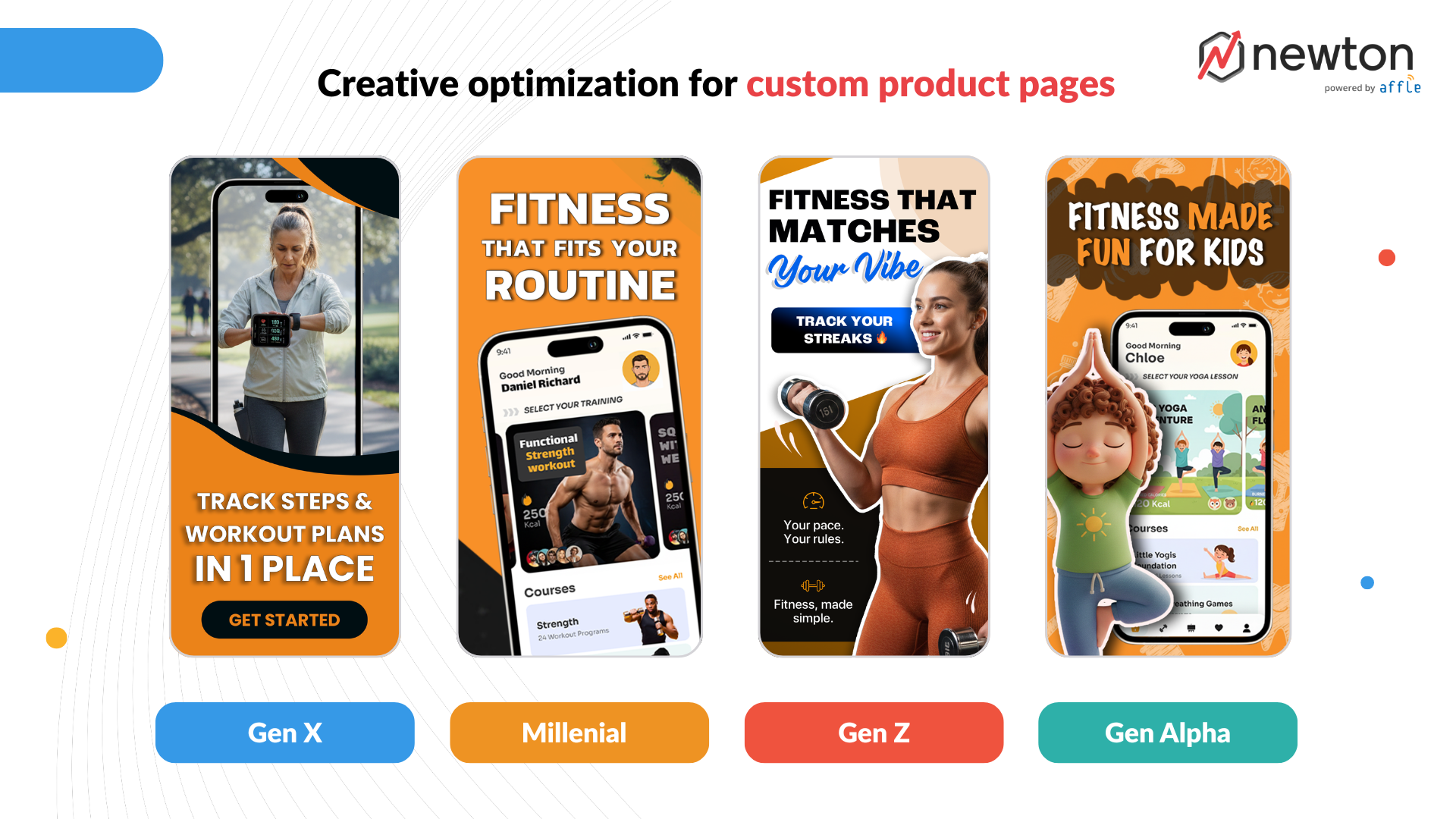
Custom product pages are where you can actually tailor the store experience by intent cohort, without changing your core listing. The goal is simple: make them feel like the “right answer” to why the user searched.
Visuals and screenshot order
Messaging and tone
Colors and design system
CTA and offer framing
App Store allows you to create up to 70 custom product pages per app. The best practice is to keep custom product pages focused on a small set of intent cohorts you can maintain and iterate weekly. You can also add deep links to these custom product pages, so users land directly in the most relevant in-app experience after tapping your ad, making the journey faster and more engaging.
 Apple Ads campaign structure: build for relevance, not reach
Once your keywords are grouped by intent and mapped to the right custom product pages, Apple Ads campaign structure becomes much simpler: don’t treat all traffic as equally ready, route each intent bucket to the custom product page that matches why the user searched.
Task-ready intent campaigns (often Gen X-linked behavior)
Focus on exact match types, higher emphasis on tap-through rate, and limited exploratory expansion. Users are already late in the funnel, so relevance matters more than scale.
Evaluative intent campaigns (often millennial-linked behavior)
Confirmation intent campaigns (often Gen Z-linked behavior)
Structure Apple Ad campaigns around brand, competitor, and trend-led terms, campaigns capture users after social discovery, making visual and narrative alignment between ads and product pages critical.
Parental intent campaigns (often Gen Alpha-linked behavior)
Map safety and age-appropriate keywords to trust-forward custom product pages and evaluate success beyond immediate installs, since approval flows (like Ask to Buy) can delay conversions.
The strategic takeaway for app marketers
Generational marketing on the App Store isn’t about age-based campaigns; it’s about understanding intent maturity. Gen X installs when the app feels certain and useful, Millennials when the value is clearly justified, Gen Z when the store experience matches what they’ve already seen, and Gen Alpha when fun meets parental trust. The path forward is intent routing: align your keyword buckets, search-result cues, creatives, product pages, and Apple Ads structure to the mindset behind the search.
