





ASO today is a full growth system, shaping how users discover, evaluate, and choose apps across search, browse, and beyond. Part 1 of our blog breaks down how visibility is actually built, from platform mechanics and keyword strategy to competitor intelligence and demand mapping.
Every day, millions of users turn to the App Store in search of solutions. Whether an app gets discovered and downloaded depends on how effectively the App Store Optimization (ASO) strategy is designed.
This guide walks through the complete system: how to build an ASO keyword portfolio that captures demand at every stage, what actually moves app installs, and how the best-performing apps use every available discovery surface. Concrete, specific, and built for app marketing teams serious about organic growth on the App Store.
1. The App Store Criteria
The App Store indexes three fields: App Name (30 chars), Subtitle (30 chars), and a hidden 100-character Keyword Field. The long description is not crawled for search and keyword density, which does not influence iOS rankings.
Indexation is binary: you're either indexed for a term, or you're not. Every character in the keyword field must earn its place. Don't repeat words already in your title or subtitle as the App Store indexes those automatically.
Three levers beyond the basics: Screenshot captions are widely reported by ASO practitioners to be indexed as keyword metadata, suggesting your creative may directly influence discoverability, not just conversion. Custom product pages have been observed to surface for organic search queries, potentially enabling intent-matched listings instead of just default screenshots.
In-App Purchase names are reported to be indexed; for example, a plan called '30-Day Weight Loss Challenge' may appear for queries your core metadata never touches.
2. The Keyword Strategy
The organic keyword strategy for App Store Optimization should be all about building coverage across intent stages, competitive dynamics, and lifecycle phases without over-reliance on any one single point of failure.
A. The Three-Bucket Portfolio
Structure your keywords across three functions:
1. Defensive (brand, core use case, primary features) to capture users already looking for you;
2. Offensive (competitor names and their feature language) to intercept demand from alternatives
3. Exploratory keywords (long-tail, adjacent, and emerging queries) to capture low-competition traffic before it becomes crowded.
Try to refresh the full ASO keywords portfolio every 4-6 weeks since search behavior shifts faster than most app growth teams tend to update metadata.
B. Indexation vs. Ranking
Indexation is whether your app appears for a search term at all. Ranking is where you appear. Both require different inputs.
1. Indexation is driven by metadata: keyword presence in your title, subtitle, and keyword field.
2. Ranking is driven by behavioral signals: conversion rate on impressions, retention, review volume, and download velocity.
In simple terms, indexation gets your app into the race; ranking determines whether users actually see it.
3. Keyword Lifecycle: Launch → Growth → Scale
Your app’s keyword strategy should evolve with your app's competitive authority. For example:
1. At launch, target lower-competition terms to achieve top-5 rankings quickly and build the behavioural signals needed for harder terms later. Going after category head terms immediately results in ranking 80th with no meaningful traffic.
2. In the growth stage, expand to mid-competition terms by introducing competitor keywords & long-tail intent phrases and filter for terms converting impressions to installs.
3. At scale, contest category head terms once you have the authority to rank in the top 3–5 positions because click-through rates drop steeply after position 5, and traffic is generally negligible below position 10.
One specific multiplier for the App Store: Keywords indexed across two or more local markets can surface in App Store searches globally, making localization a powerful discoverability strategy.
3. Competitor Analysis = Category Intelligence
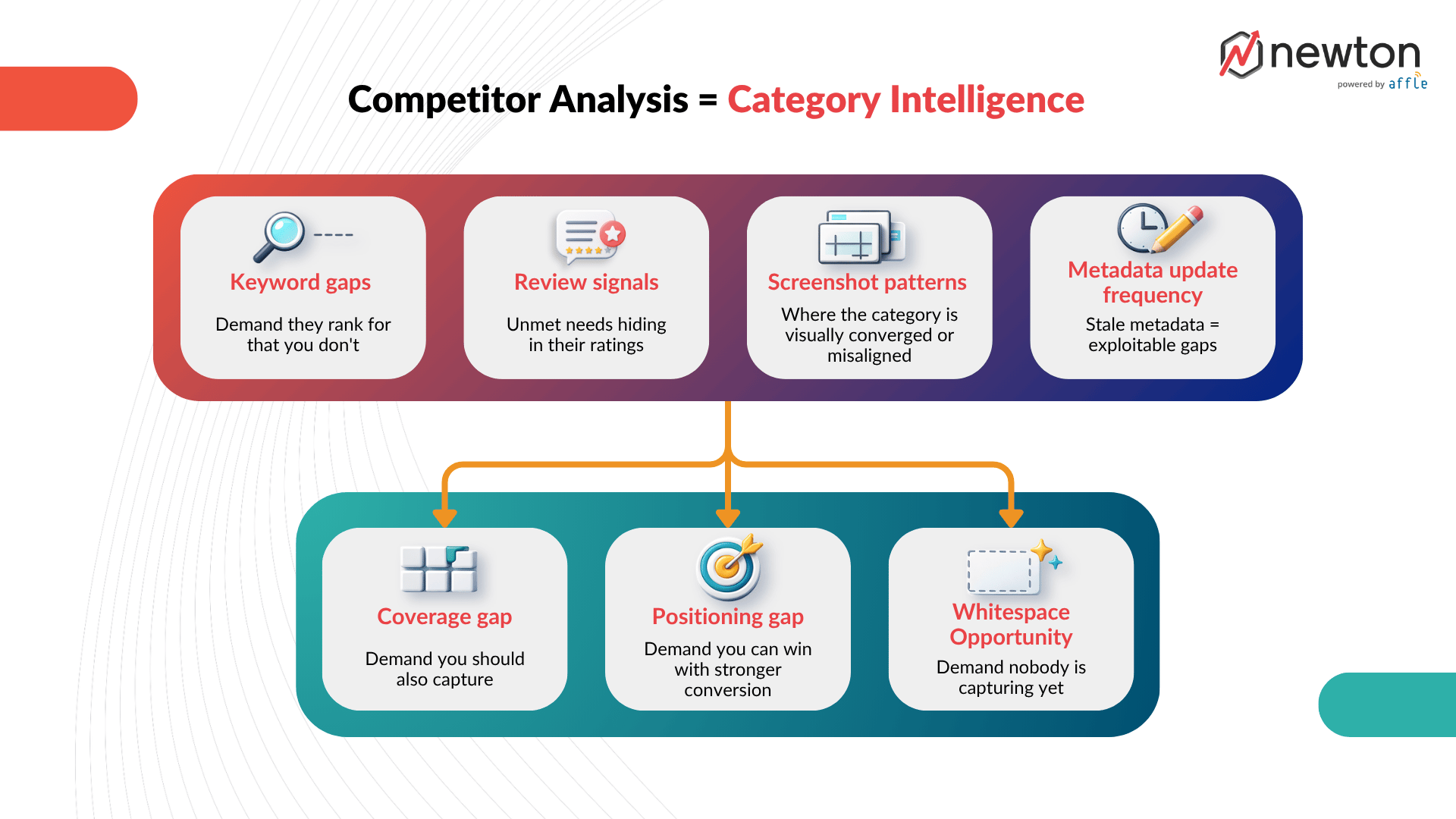
Competitor analysis for ASO, when done well, goes beyond finding the gaps in keyword strategy. It reveals how demand is structured across the category and where your app fits within that structure inside the App Store.
A. Category Hierarchy: Know Your Position
Every category has an implicit hierarchy that determines your strategy:
1. Category leaders own high-volume head terms and set the visual and messaging conventions others default to.
2. Challengers contest leaders by owning the second or third most common use case, attacking on specific dimensions (speed, affordability, a feature), and exploiting keyword gaps where leaders are under-optimized.
3. Niche players win on specificity by owning a sub-segment with enough depth that generalists can't match them, with keyword strategies built around long-tail intent and stronger conversion from high-specificity users.
Your position determines which keywords are contestable, what messaging is available, and whether you're competing for existing demand or creating it.
B. What to Extract from Competitor Analysis
Audit competitors across four dimensions:
1. Keyword gaps: Terms top competitors rank for that you aren't indexed to represent demand already being captured at your expense.
2. Review signals: Top themes in competitor reviews (positive and negative) are the clearest indicators of unmet category demand. For instance, if their users consistently cite complexity and your app is simpler, that's a notable positioning differentiation.
3. Screenshot patterns: When every top app uses the same visual structure, an outcome- or narrative-first approach may stand out. Conversely, if all competitors emphasize a dimension your app ignores, you may be misaligned with category expectations.
4. Metadata update frequency: Competitors actively refreshing keywords signal ongoing optimization; those who haven't updated in months likely have exploitable gaps.
Important: Classify all findings into three buckets: demand you should also be capturing (coverage gap), demand you can capture with stronger conversion (positioning gap), and demand no competitor is capturing yet (whitespace opportunity).
What Comes Next
Ranking is a visibility problem, and we have covered the foundation of a strong ASO strategy: getting indexed for the right terms, understanding category position, and building a keyword portfolio that compounds over time.
But even a well-ranked app loses the majority of users who see it. The average App Store impression-to-install rate sits in the low single digits, typically around 3-4%, meaning ranking creates visibility, but conversion determines whether that visibility translates into growth. Doubling conversion rates can double installs without gaining a single additional ranking position, making conversion optimization a growth lever equal in importance to everything covered in this guide and one that remains largely within an advertiser's control.
Part two explores where the visibility system meets the conversion system: what drives install decisions, how creatives communicate value during the few seconds users spend scanning search results, and why the visual layer is the one aspect of ASO that competitors cannot easily reverse-engineer. The infrastructure is in place; now it's time to optimize the funnel.
